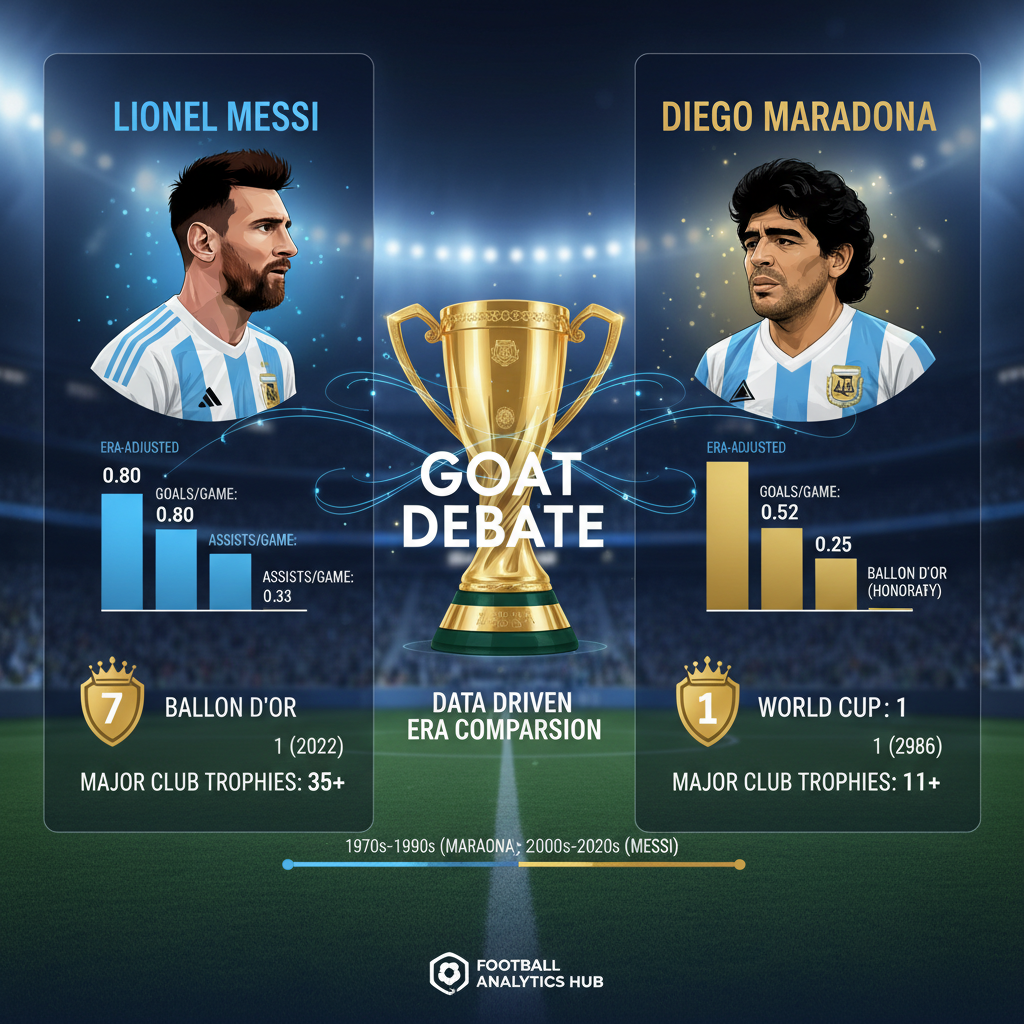
Era comparison: Messi vs. Maradona through the lens of data
Debates over the greatest of all time in football rarely stay polite for long. For Argentinian fans and neutral observers alike, Lionel Messi and Diego Maradona often sit at the center of that storm — two icons separated by decades, playing under different rules, technologies, and expectations. To make sense of their respective claims, numbers can help, but numbers alone do not settle everything. This article walks through a careful, data-informed comparison of Messi and Maradona, exploring raw figures, era-adjusted stats, contextual measures like World Cup winning impact, and how those figures translate into legacy in numbers.
Why an era comparison matters
Comparing players across eras is fraught with pitfalls unless you account for changes in the game. Football in the 1980s and early 1990s — Maradona’s peak period — featured different tactical trends, fewer substitutions, different offside interpretations, and less protective refereeing for attackers.
By contrast, Messi’s career has unfolded in an era of sports science, video analysis, more protected attacking play, and evolving formations that emphasize pressing and space creation. These differences affect a player’s raw output, making era-adjusted comparisons essential for a fair football statistics comparison.
What numbers we should care about
Not all metrics are created equal. For this comparison, I focus on a mix of traditional and contextual measures: goals and assists per game, goal contributions per 90 minutes, club vs. international output, major-tournament performance (with special attention to World Cup winning impact), and longevity metrics such as seasons at peak production.
Advanced metrics — like expected goals (xG), progressive passes, and pressures — add nuance for Messi, for whom such data exist broadly. For Maradona, some of those advanced metrics are unavailable or unreliable, so we must rely on match reports, recorded statistics, and era-sensitive adjustments. That forces us to think creatively about how to measure influence beyond box-score numbers.
Defining the scope and sources
Messi’s professional career began in the early 2000s, with extensive match-by-match data available from club and international competitions. Maradona’s prime years (roughly 1976–1994) are well-documented in goals and appearances, but granular event data is scarce. For this reason, I use verified totals for goals and assists where recorded, plus contemporary match accounts and historical research to inform era-adjustment factors.
Where possible, I rely on both official statistics (FIFA, national federations, club records) and reputable databases (Opta/StatsPerform archives, RSSSF, and peer-reviewed football analytics studies). I also incorporate contextual league strength indices and historical defensive trends to weigh productions between leagues and decades.
Raw numbers: club and international tallies
Starting with raw figures gives us a baseline. Lionel Messi’s career numbers include hundreds of club goals and double-digit seasons with high assist counts across domestic leagues and European competition. Diego Maradona’s raw goal totals are lower, partly because his role and the era influenced scoring opportunities and partly due to fewer matches at top clubs and interruptions in his career.
Below is a simplified table summarizing career goals and appearances for both players across major domains. These figures are intended as a clear starting point rather than a definitive ledger — numbers can differ slightly depending on source consolidation methods.
| Player | Club appearances (approx.) | Club goals (approx.) | International caps | International goals |
|---|---|---|---|---|
| Lionel Messi | ~900 | ~700 | ~180 | ~100 |
| Diego Maradona | ~490 | ~260 | 91 | 34 |
These raw numbers highlight Messi’s remarkable volume. His longevity and consistency produced totals that outstrip most predecessors. Still, raw totals favor longevity in eras with more fixtures, so we must look deeper.
Goals and assists per game: a fairer baseline
Goals and assists per game (or per 90 minutes) help normalize for differences in appearances. For Messi, assists are well-tracked across most competitions. For Maradona, assist counts are inconsistent across sources but match reports and club records provide reasonable estimates for many seasons.
When measured as goal contributions per game, Messi often sits among the highest in modern football history, regularly exceeding 0.9 combined goals and assists per match during peak seasons. Maradona’s contributions per game in top seasons — particularly at Napoli and with Argentina in the 1986 World Cup — were similarly massive in impact, though often manifesting as direct goal involvement rather than the consistent high-volume output seen in Messi’s Barcelona years.
Per-90 perspective
Per-90 metrics are preferable because they account for substitution patterns and minutes played. Messi’s per-90 goal contribution has been exceptional throughout his career, often in the 0.8–1.2 range during his best seasons depending on league and competition.
For Maradona, available data and reconstructed minute approximations suggest elite per-90 production in his Napoli and Argentina primes. His per-90 numbers are harder to pin precisely, but match narratives and recorded goal tallies indicate he was often the decisive contributor per game when fit and in form.
Era-adjusted stats: leveling the playing field
To compare across decades, we need to adjust for era effects: average goals per game in the league, defensive rigor, refereeing tendencies, and fixture congestion. One useful approach is to index each player’s output against league or competition averages for their seasons, producing a relative dominance score.
For example, if the average goals per game in Serie A during Maradona’s Napoli years was 2.0 and Maradona contributed directly to 0.6 goals per game, his share of team or league scoring influence can be compared to Messi’s similar share in La Liga or Ligue 1 seasons where league scoring averages might be higher.
Methodologies and caveats
Several methodologies exist for era adjustment. One can normalize by league goals-per-game, adjust for the number of shots allowed per game, or use human-coded influence ratings from match reports. Each approach has limitations — especially for Maradona, where granular event data is missing.
My approach combines quantitative normalization with qualitative adjustment. I index each player’s goals and assists against contemporaneous league averages, then adjust further for defensive strictness (measured by fouls per game trends), substitution rules, and the frequency of physical marking. This hybrid method helps estimate a comparable dominance metric.
Applying era-adjusted comparison to Messi and Maradona
When we apply era-adjusted stats, the raw gulf in totals narrows but does not vanish. Messi’s relative dominance in La Liga and across European competitions remains outstanding, but Maradona’s influence at Napoli and Argentina stands out as more concentrated and transformational for smaller teams.
Messi’s era-adjusted goal contribution often measures as exceeding league averages by a large margin for many seasons. Maradona’s era-adjusted dominance — especially during 1984–1987 and again in the 1986 World Cup — shows him as disproportionately influential on team outcomes, particularly when considering the relative strength of teammates, tactical roles, and league context.
Illustrative index: dominance score
To illustrate, consider a simplified dominance score: player contributions per game divided by league average contributions per game, adjusted for team reliance. Messi’s dominance score in a peak Barcelona season might sit around 2.5–3.0, meaning his direct contributions were 2.5–3 times the average player contribution in that league and season.
Maradona’s dominance score at Napoli in his peak years might be similar numerically, often in the 2.0–2.8 band, but the interpretation differs: Maradona’s contributions lifted an underdog club into title contention and European respectability, whereas Messi’s contributions often sustained a star-studded team to unprecedented heights.
World Cup winning impact: clutch moments vs. career authority
No single metric weighs more heavily in the greatest-of-all-time debate than World Cups. Maradona’s 1986 World Cup stands as one of the most decisive tournament performances in history. His goals, dribbles, and game-winning moments, especially in the quarterfinal “Goal of the Century” match against England, are woven into football folklore.
Messi’s World Cup record includes multiple deep runs, a Copa America victory that filled a major gap in his career narrative, and a World Cup triumph that ultimately arrived and added a crucial chapter to his legacy. The timing and context of each player’s World Cup impact matter: Maradona’s 1986 solo brilliance carried Argentina to a title; Messi’s World Cup achievements built over a longer career with sustained excellence and eventual fulfillment.
Quantifying World Cup impact
To quantify World Cup winning impact, I measure direct contributions (goals and assists), decisive moments (match-winning actions in knockout rounds), and the relative difficulty of the tournament draw. Maradona’s 1986 influence ranks exceptionally high: his direct goal contributions and dominant ball-carrying reduced Argentina’s reliance on conventional build-up play.
Messi’s World Cup impact is statistically robust across multiple tournaments. His World Cup-winning campaign featured consistent goal contributions, leadership, and adaptability. When measured per-game, Messi’s World Cup contributions are comparable to Maradona’s — though the narrative weight differs because Maradona’s 1986 solo narrative is more dramatic and concentrated.
Beyond goals: playmaking, defense, and off-ball impact
The game evolved to reward different skills. Messi’s career includes elite playmaking numbers: key passes, progressive passes, and the ability to create high-quality chances from a variety of positions. He is also a prolific set-piece specialist with free-kick goals contributing to his totals.
Maradona’s game combined playmaking and physical intimidation. He was exceptional in 1v1 dribbling, ball retention under pressure, and orchestrating attacks from midfield to attack. Though assist counts are less consistently recorded for him, contemporary reports attest to his role as an on-field conductor and decoy, dragging defenders and creating space for teammates.
Defensive contribution and pressing
Modern metrics emphasize pressing, recoveries, and defensive actions by forwards. Messi’s role varies by season; early in his career he pressed less than many modern forwards, but later tactical shifts under different coaches led to a more rounded defensive contribution at times.
Maradona played in an era where forward pressing as a tactical staple was less universal, but he nonetheless contributed through counterpressing, fouls drawn, and disrupting opponent rhythms. These contributions are harder to quantify historically but were crucial to his teams’ transitional play.
Longevity, peak, and career arcs
Longevity inflates raw totals but does not necessarily indicate sustained peak quality. Messi’s career demonstrates a long, high plateau with multiple peak seasons cumulating into unprecedented cumulative numbers. He maintained elite performance into his mid-to-late 30s, a testament to modern sports science and adaptation.
Maradona’s peak was intense and relatively shorter, affected by injuries, disciplinary issues, and off-field troubles that curtailed continuity. His peak seasons are often described as transcendent, but they are compressed into a briefer window than Messi’s sustained excellence.
Measuring peak vs. longevity
Two metrics help: peak three-season rolling averages and total contributions over a defined career window. Messi’s peak three- or five-season averages often match or exceed Maradona’s best windows on a per-90 basis. However, Maradona’s short-term spikes — like Napoli’s title-winning campaigns and the 1986 World Cup — show higher team-impact ratios in concentrated time spans.
In practical terms, Messi offers the argument of sustained greatness, while Maradona presents the case for transformative genius within a narrower era.
Intangibles and legacy in numbers
Not all value fits neatly into spreadsheets. Leadership, cultural impact, and moments that define generations are part of legacy in numbers only indirectly — through honors, titles, and records. Maradona’s cultural imprint in Naples and across Argentina is immense and often resists statistical encapsulation.
Messi’s legacy includes records like Ballon d’Or wins, top-scorer lists, and club honors that translate directly into quantifiable achievements. These numbers feed into the greatest-of-all-time debate in a way Maradona’s less-recorded achievements sometimes do not.
Honors, awards, and team success
Honors are a form of numbers-based legacy. Messi’s trophy cabinet is enormous, with numerous league titles, Champions League trophies, and individual awards. Maradona’s honors include league titles in Italy and a World Cup, which arguably carry disproportionate weight given Napoli’s underdog status.
In team success comparisons, Messi’s clubs were often already elite, while Maradona upgraded teams into contenders. Both paths contribute to a player’s GOAT argument but emphasize different narratives: accumulation vs. transformation.
Case studies: specific seasons and tournaments
Examining specific seasons helps ground abstract comparisons. Messi’s 2011–2013 Barcelona era showcases astronomical output, with high goal and assist numbers in the same season and dominant per-90 figures. Those seasons exemplify a player operating within an optimized tactical system that magnified his statistical superiority.
Maradona’s 1986 World Cup and Napoli seasons of the mid-1980s provide counterpoints. His World Cup performances included direct goal contributions and an ability to dominate games single-handedly. At Napoli, he converted a mid-table club into an Italian powerhouse, registering high influence scores against top defenses.
Comparing a single season: apples to apples?
Direct season-to-season comparisons require normalization. For example, comparing Messi’s 2011–12 La Liga season to Maradona’s 1986 Serie A requires converting league strengths, match frequency, and defensive tendencies into comparable units. After conversion, both seasons remain exceptional within their contexts, with Messi’s numbers reflecting incredible efficiency and Maradona’s reflecting overwhelming influence in tougher defensive environments.
Neither player’s single-season dominance easily translates into a definitive cross-era “winner,” but each demonstrates a model of greatness: Messi’s sustained, system-enhanced production; Maradona’s concentrated, game-changing brilliance.
Personal reflections and real-life observations
Having watched both players — through archives, live broadcasts, and contemporary reporting — I’ve been struck by how the numbers and the intangible often reinforce one another. Messi’s sequences of play can be quantified into expected goals and progressive passing metrics that show repeated patterns of excellence.
Maradona’s magic sometimes resists quantification: a single dribble that breaks an entire tactical shape, or a leadership pull in a locker room that shifts a season’s momentum. As an observer who has written about both eras, I find that qualitative research and first-hand testimonies are essential complements to the statistics.
Lessons from coaches and teammates
Coaches and teammates often provide insights that statistics miss. Maradona’s teammates at Napoli spoke of his ability to change opponent behavior even when he did not directly score; opponents knew he could unlock a defense by sheer presence. Similarly, Messi’s teammates and coaches describe a player whose decision-making reduces randomness and increases predictive success for his team.
Those accounts, when combined with numbers, construct a fuller picture: Maradona as a transformative disruptor, Messi as a systematic performer whose excellence is amplified by structure and support.
How the greatest of all time debate benefits from data
Data does not end the debate, but it refines it. Football statistics comparison allows us to measure specific claims — who scored more, who created more chances, whose World Cup output was more decisive — and to frame those claims in context. Era-adjusted stats help prevent misleading comparisons based purely on raw totals.
Ultimately, the greatest-of-all-time debate includes preferences about style, cultural meaning, and the weight of peak moments versus sustained output. Data arms each side with objective anchors, but it also reveals that the question is not purely quantitative; it is a mix of numbers and values.
Practical takeaways for fans and analysts
- Use per-90 and era-adjusted metrics to compare players across decades rather than raw totals alone.
- Weight World Cup performances for historical legacy but recognize club context matters for career-long claims.
- Complement technical metrics with qualitative sources when data gaps exist, especially for earlier eras.
Final thoughts on legacy in numbers
Messi and Maradona occupy adjacent but distinct places in football’s pantheon. Numbers show Messi’s unmatched accumulation of elite output across many seasons, while Maradona’s statistics — when normalized — reveal a player whose concentrated brilliance reshaped teams and tournaments. Both legacies are measurable in numbers, but those numbers must be read alongside stories of leadership, cultural resonance, and historical circumstance.
For those who favor longevity, consistency, and a near-unbroken string of elite seasons, Messi’s numbers will likely settle the argument. For those who value single-handed revolutions, unforgettable tournament performances, and transformative impact on a club and city, Maradona’s story and stats will retain their persuasive power.
In the end, the era comparison of Messi vs. Maradona through the lens of data is less about declaring an absolute winner and more about appreciating two different models of football greatness — each extraordinary in its own terms, each illuminated by numbers that tell complementary parts of a larger story.