
How to read the game: using live data to sharpen your football bets


Watching a match unfold and seeing an opportunity before the bookmaker adjusts the price is a quiet thrill few bettors describe well.
Live football data, when read correctly, turns passive viewing into active decision-making and lets you act on momentum, match events, and evolving probabilities.
Why live scores change the betting game
Traditional pre-match bets rely on form, injuries, and historical data, but football is an organic sport: a red card, a tactical shift, or a sudden downpour can rewrite expectations in minutes.
Live football scores betting opens the door to capturing value that pre-match markets miss, because odds lag behind real-time information and human intuition.
Using live data gives you a numerical compass: it helps separate gut feelings from evidence when you must decide whether to lock in a cash-out, hedge, or place a new bet.
What live score feeds show and how reliable they are
Live feeds typically provide goals, cards, substitutions, time elapsed, and sometimes deeper metrics like shots, corners, and expected goals (xG).
Not all providers are equal—some aggregate official match reports, others use automated optical tracking, and a few blend manual input with algorithmic checks for speed.
Reliability depends on the provider’s data sources and latency. The difference between a one- to three-second delay and a 20-second delay can mean placing a bet before odds reflect a new reality.
Sources of live football data
Official league APIs and broadcast partners provide highly accurate timestamps but often limit access to commercial clients.
Third-party aggregators and betting exchanges collect data from various legal feeds and can be remarkably fast, though occasional human error is possible.
Independent services using computer vision and on-field sensors are improving rapidly; verify their transparency about methodology before trusting their metrics for money decisions.
Latency, accuracy, and how to account for both
Latency — the delay between an event and its appearance in your app — is the silent cost of live betting. Platforms vary, so test several during slow and fast matches.
Accuracy matters more for complex stats like xG than for simple events like a goal. Spot-check goals and cards across apps to find consistent feeds you can rely on.
When latency cannot be eliminated, adapt strategy: aim for markets that tolerate small delays, such as next-goal windows or total goals, rather than markets requiring millisecond precision.
Essential tools for following live football scores
A fast, trusted live score app is the foundation, but successful live bettors build a dashboard: a scores feed, an odds monitor, and a statistics panel.
Many pros run multiple screens or split-screen mobile apps to maintain situational awareness. The goal is to avoid surprises—you want to know the full context within seconds of any event.
Choose tools that allow alerts for specific events, real-time odds streaming, and quick bet placement on the same device to reduce friction when a clear edge appears.
Recommended features to look for
Instant push notifications for goals, red cards, or penalty kicks are invaluable because they allow you to react without constantly watching the match.
Live odds comparison widgets let you spot when a single bookmaker is slow to adjust, which is often where value hides for a few seconds.
Access to key match stats—shots on target, attacking possessions, corners, expected goals—helps quantify momentum instead of guessing it.
Balancing speed and reliability in platform selection
Some apps prioritize speed at the expense of context, while others add commentary and extra metrics but with a small delay. Decide which trade-off suits your style.
If you place many live bets, speed and stable bet routing are priorities. If you place fewer, higher-stakes bets, deeper analytics might be worth a slight latency cost.
Test platforms during non-critical matches to see how they perform under load. Real-world testing beats marketing claims every time.
Key in-game metrics and what they tell you
Not all statistics matter equally. A corner can mean little in isolation, but a sequence of corners, shots, and high possession in the same attacking third suggests sustained pressure.
Shots on target and big chances provide more predictive power for scoring than raw possession numbers, because football is about opportunities turned into goals.
Expected goals (xG) measures the quality of chances and is especially useful in live betting, since it separates luck from likelihood and signals probable future outcomes.
| Metric | What it indicates | How to use it live |
|---|---|---|
| Shots on target | Immediate scoring pressure | Consider backing an in-play goal market if sustained |
| Expected goals (xG) | Chance quality | Use to anticipate eventual goals despite current scoreline |
| Corners | Attacking territory | Good for short-term momentum and corner markets |
| Fouls/cards | Physicality and game control | Adjust risk for penalty and card markets |
| Possession in final third | Control near goal | Combine with shots to predict odds shifts |
Interpreting xG in the moment
xG is a running total of the quality of chances created. It tells you whether a team’s current lack of goals is unlucky or genuinely unlikely to change.
In live markets, a team underperforming its xG may be due for a goal, which can create value in odds for the next 15–30 minutes.
Conversely, a team outperforming xG might be riding temporary fortune; you should be cautious about chasing winners in that scenario.
Momentum versus isolated events
Consecutive promising attacks are more meaningful than a single long-range shot that flies narrowly wide. Context matters: where the action happens on the pitch and how teams respond afterward.
Watch for tactical cues—substitutions, formation shifts, and a coach’s body language—which often precede or explain statistical swings and help you anticipate changes in live odds.
Using metrics together—shots, xG, and final-third possession—gives you a clearer picture of momentum than any one statistic alone.
Popular live-betting markets and when to use them
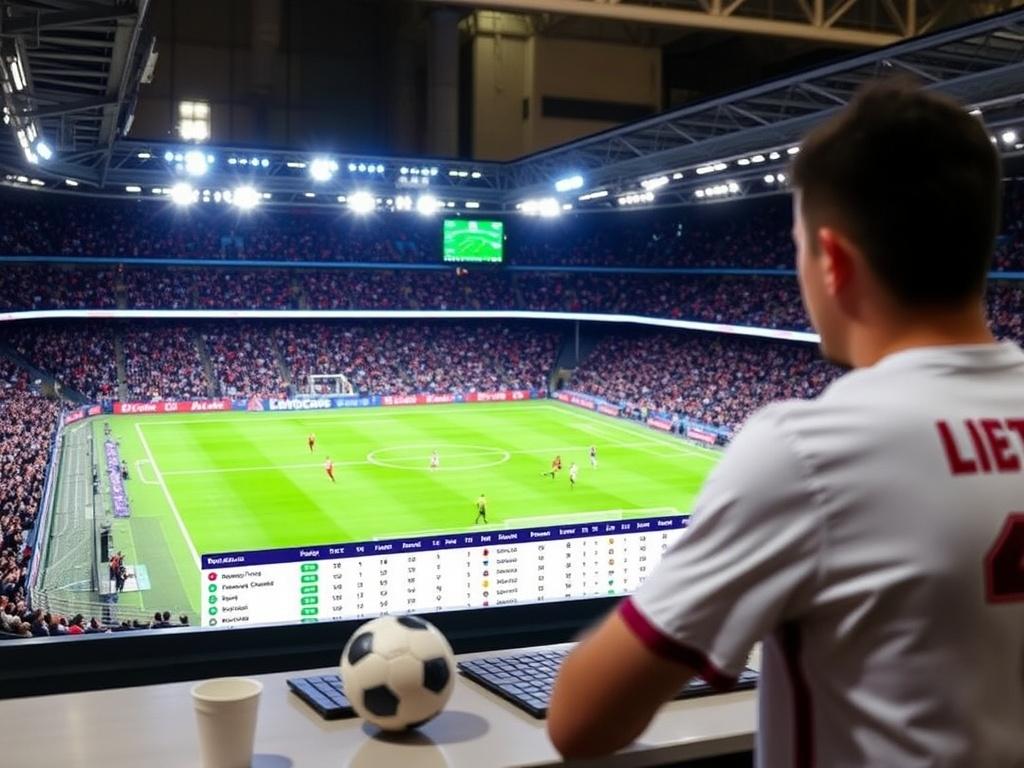
Not every market is suitable for live play. Some, like next-goal or in-play totals, respond directly to immediate events and are therefore good targets for live strategies.
Markets such as correct score can swing wildly with each goal and may offer value if you quickly recognize patterns of domination or collapse.
Markets like “first half result” are useful in the early stages of a match for bettors who track slow-building teams that score late.
Picks for conservative in-play bettors
If you prefer lower variance, aim for smaller, more predictable markets: Asian handicaps with minimal goals difference or low-liability over/under lines.
Hedge pre-match positions when an unexpected event (like an early red card) threatens your exposure; in-play cashouts can protect your bankroll.
Use staking rules that reduce size after adverse events; conservative bettors accept smaller returns in exchange for stability.
Higher-risk, higher-reward plays
Backing a team to score next after a sequence of shots on target can yield attractive odds, but requires nimble execution and confidence in your timeline.
Try half-time transfers—betting on second-half outcomes after observing first-half patterns—when you spot tactical shifts the market hasn’t priced.
Combining live accumulation bets across multiple matches is risky but can produce bigger returns with disciplined stake control and strong reasoning.
Timing: when to act and when to wait
Speed is only valuable when combined with clarity. Hastily placed bets on noisy signals lead to losses faster than slow decisions.
Wait for confirming signals: a foul indicating tactical frustration, a substitution that weakens defense, or a pattern of high-quality opportunities.
If multiple key indicators align—xG rising, shots on target, and a stagnant goalkeeper—you have stronger justification than for a single flash event.
Seconds matter: practical timing rules
A simple rule is to avoid reacting in the first 10 seconds after a goal or major incident; odds can be chaotic and markets may still be updating.
Conversely, certain windows require immediate action: penalty kicks, red cards, or an obvious injury. Decide in advance which events demand instant response.
Set predefined triggers in your apps—alerts for specific events reduce reaction time and prevent emotional decision-making under pressure.
When the market moves before the stat does
Market sentiment often moves faster than raw stats when bettors collectively sense momentum. Watch for odds drift as a sign of the market’s expectation.
If odds are moving but stats don’t justify it, look for hidden factors: crowd energy, referee history, or remote reports about injuries that the data feed hasn’t captured.
Be cautious about following the crowd; identify whether the market is reacting to real events or noise before placing money.
Bankroll management for live betting
Live betting tempts increased activity because opportunities continually appear. Without discipline, that leads to rapid bankroll erosion.
Set limits on the number of live bets per match and per day, and cap stakes as a percentage of your overall bankroll to manage variance.
Use position-sizing rules that respond to confidence levels—smaller stakes for speculative plays, larger for high-probability situations supported by multiple metrics.
Staking models that suit in-play action
Flat staking keeps losses predictable and is easy to manage. It’s ideal for beginners or when you lack a clear edge in a single market.
Kelly-based approaches optimize growth but require accurate win probability estimates; they are powerful when you can quantify edges consistently.
Hybrid models—fractional Kelly or fixed proportion plus add-ons for high-confidence plays—balance growth and risk in volatile live environments.
Protecting your bankroll from emotional swings
Live betting amplifies emotional reactions. When a favored team concedes unexpectedly, many bettors double down to chase losses; this is a mistake more than half the time.
Use automated limits on staking and loss thresholds per session to force a pause when you’re tilting emotionally.
Regularly audit your session logs to identify patterns of emotional betting and adjust rules to mitigate repeat mistakes.
Common cognitive traps and how to avoid them
Recency bias makes a late flurry of attacks seem more predictive than they really are, while confirmation bias makes you notice only data that supports your hunch.
Confirmation is especially dangerous during live play: once you commit emotionally, you’ll interpret neutral events as supportive evidence.
Quietly record the reasons for each live bet—just a sentence—so you can assess whether your decisions were analytic or emotional after the match.
Overreacting to single events
A single mounded chance that didn’t result in a goal should not overhaul your view of a match unless it’s part of a cluster of similar events.
Develop rules for minimum evidence—two or three related events—before increasing exposure, and stick to them regardless of how compelling a single event feels.
This discipline prevents wild swings and keeps your betting grounded in repeatable processes rather than dramatic but isolated moments.
The gambler’s fallacy and streak thinking
Streaks in football are driven by underlying conditions, not mystical runs. Treat streaks as data to explain, not as causal forces to bet on blindly.
Always ask what changed: tactical approach, injuries, or scheduling. If you can’t identify a rational explanation for a streak, hesitate before changing stake size.
Counting outcomes without considering probability leads to poor choices; instead, translate streaks into statistical measures of edge before acting.
Combining live scores with predictive models

Many bettors use simple in-play heuristics, but you can also feed live data into predictive models that update probabilities in real time.
Models can incorporate xG, shots, and possession to output win/draw/lose probabilities and suggest value relative to the bookmaker’s odds.
Even basic models—logistic regression or a Bayesian update—improve decision quality by forcing you to quantify your beliefs rather than relying solely on intuition.
Practical model design for live markets
Start with variables that update quickly: current score, time remaining, shots on target, and xG differential. Keep models simple to avoid overfitting to small samples.
Validate your model on historical in-play sequences. Look for predictive power in short time windows (5–30 minutes) rather than full-match outcomes only.
Use model outputs to inform stakes relative to perceived edge. A model doesn’t have to be perfect; it just needs to be better than your unstructured judgment on average.
When intuition trumps the model
Sometimes live context—bad weather, a visibly injured player, or a tactical surprise—matters more than what the model knows. Design a protocol for overriding models when clear evidence appears.
Tag model overrides and review them later to ensure you’re not systematically ignoring useful model insight for emotional reasons.
Balance is key: models provide consistency, intuition offers flexibility—use both with clear rules about when each governs decisions.
Real-life examples that illustrate successful live betting
I remember a midweek cup tie where a second-division team dominated early but had a single goalkeeper save keeping the top-division side level.
By tracking xG and shots on target, I placed a modest next-goal bet near halftime; the underdog finally broke through in the 52nd minute when pressure told its story.
That bet wasn’t a lucky guess—it was a measured risk based on pattern recognition and quick execution when odds still reflected uncertainty.
A failed live bet and what I learned
Once I chased a team that had hit the woodwork twice in quick succession and presumed a goal was imminent. I staked too large relative to my edge.
The match settled into a midfield scrimmage and the price drifted against me, teaching a hard lesson: high emotional confidence without corroborating metrics is dangerous.
Since then, I require at least two independent indicators before increasing stake size in live situations.
Legal, ethical, and practical considerations
Live betting availability and rules vary by jurisdiction. Always verify the legality of in-play betting in your area and follow local regulations.
Casinos and bookmakers may restrict or ban accounts that consistently exploit slow odds or suspected latency advantages, so be mindful of platform terms.
Practice ethical betting: don’t attempt to use illicit data feeds or insider information. Play within the rules and focus on skill-based edges instead of unfair advantages.
Responsible gambling practices for live bettors
Set session time limits to avoid marathon live-betting binges. Fatigue and tunnel vision erode judgment quickly during tight sequences of events.
Use loss and stake limits enforced by the platform or by third-party tools, and never bet money you can’t afford to lose.
Keep betting a controlled, analytical activity—if it ceases to be that, step away and reassess your approach.
Checklist: practical steps to get started with live football betting
Build a shortlist of two or three live score providers and test them on non-critical matches to measure latency and reliability.
Create an in-play dashboard that includes a live scores feed, odds monitor, and key stats like shots, corners, and xG; set alerts for events you care about.
- Define your stake size rules and a daily loss limit before kicking off a session.
- Decide which markets you’ll engage with live and which you’ll avoid due to latency sensitivity.
- Practice model-free strategies and simple models in a simulated environment before risking real money.
- Record brief notes for every live bet and review them weekly to refine your process.
Starting small and scaling sensibly
Begin with small stakes to learn timing, platform quirks, and your psychological reactions to live pressure.
As you develop consistent profitability and a documented edge, scale incrementally—never leap after a few wins.
Use clear scaling rules tied to bankroll growth and measured performance, not to ego or short-term results.
Tactics for different match types and competitions
Domestic league matches behave differently from cup ties or international fixtures. Cup games often feature rotations and different incentives, affecting live dynamics.
In knockout matches, extra time and penalty probability alter late-game value, so adjust strategies when a draw sends teams to extra time.
International matches can be slower and more tactical, with fewer chances; value often appears in unusual markets like cards or set-piece outcomes.
Adapting to team styles and managerial changes
A high-pressing manager might produce intense bursts of opportunity early, so early live markets on those teams can swing quickly.
When a team changes managers, their style and in-game adjustments change too; track recent matches to see how quickly new tactics are implemented.
Use team-level profiles—pressing intensity, susceptibility to counters, and set-piece strength—to anticipate live patterns before kickoff.
Sample team profile template
Track a handful of traits for each team you follow: attacking tempo, reliance on set plays, defensive line height, and substitution tendencies.
Use this template to interpret live events faster. For example, a team that concedes to counters but controls possession may be vulnerable late in matches when fullbacks push on.
Update profiles periodically; teams evolve across a season and yesterday’s traits may not hold indefinitely.
Practical habits that separate consistent live bettors
Consistently profitable live bettors treat activity like trading: discipline, record-keeping, and continuous improvement trump sporadic bravado.
They cultivate calmness and patience, choosing quality bets over quantity and maintaining simple rules to avoid the siren call of action for action’s sake.
Importantly, they review both wins and losses with equal rigor to find replicable patterns rather than excuses.
Daily routine for live betting
Check your bankroll and limits before the session, scan scheduled matches for likely opportunities, and confirm the reliability of your live feeds.
During play, minimize distractions: mute unnecessary feeds and focus your attention on the matches and stats that matter for your preselected markets.
After each session, log outcomes, reasons, and emotional state to keep a clean feedback loop for improvement.
Further learning and continual improvement
Study match footage after betting on a game to see whether your live read matched reality and to spot missed signals for the future.
Engage with a community of informed bettors to exchange observations — but be skeptical and test ideas yourself before adopting them.
Read widely on statistical approaches in football analytics. Understanding the principles behind metrics like xG and expected assists will sharpen your live reads.
Using live football scores for betting is a craft that blends speed, data literacy, and emotional control. Treat it like a skill you sharpen over time rather than a shortcut to quick wins.
Start small, build a reliable toolkit, and let evidence guide your choices. With disciplined application, live football odds move from noise to opportunity—and watching a game becomes a purposeful exercise rather than a gamble on hope.
